
new builder archetype
a look into the agentic engineering mindset behind clawdbot

1. Why Clawdbot is everywhere
Over the past few weeks, discussions around Clawdbot have been hard to miss. Personal AI assistants are set to be the centre of attention in 2026, and Clawdbot (now Moltbot OpenClaw) has become the “torchbearer” for the pack before Big Tech and major labs release their own versions.
GitHub stars for Clawdbot are skyrocketing.
Anthropic emailed the developer to request a name change.
Mac minis are reportedly selling out as users spin up local setups.
A social media network of personal assistants is exploding.
At first glance, it’s easy to dismiss this as just “another AI moment”, a clever demo, a fast-growing repo, and the familiar cycle of hype and skepticism. To be fair, there are reasons for skepticism: the project has rough edges and real security concerns. At the same time, it is clearly not “AI slop.” The codebase shows intent, structure, and evidence of care.
What stood out to me wasn’t just what was built, but how it was built. This was largely a one-person effort, developed rapidly and grounded in software fundamentals. It uses agents aggressively, yes, but within a workflow that emphasizes feedback, verification, and iteration.
That is the part I want to focus on. Clawdbot’s popularity is fascinating, but the engineering mindset behind it is what’s worth studying.
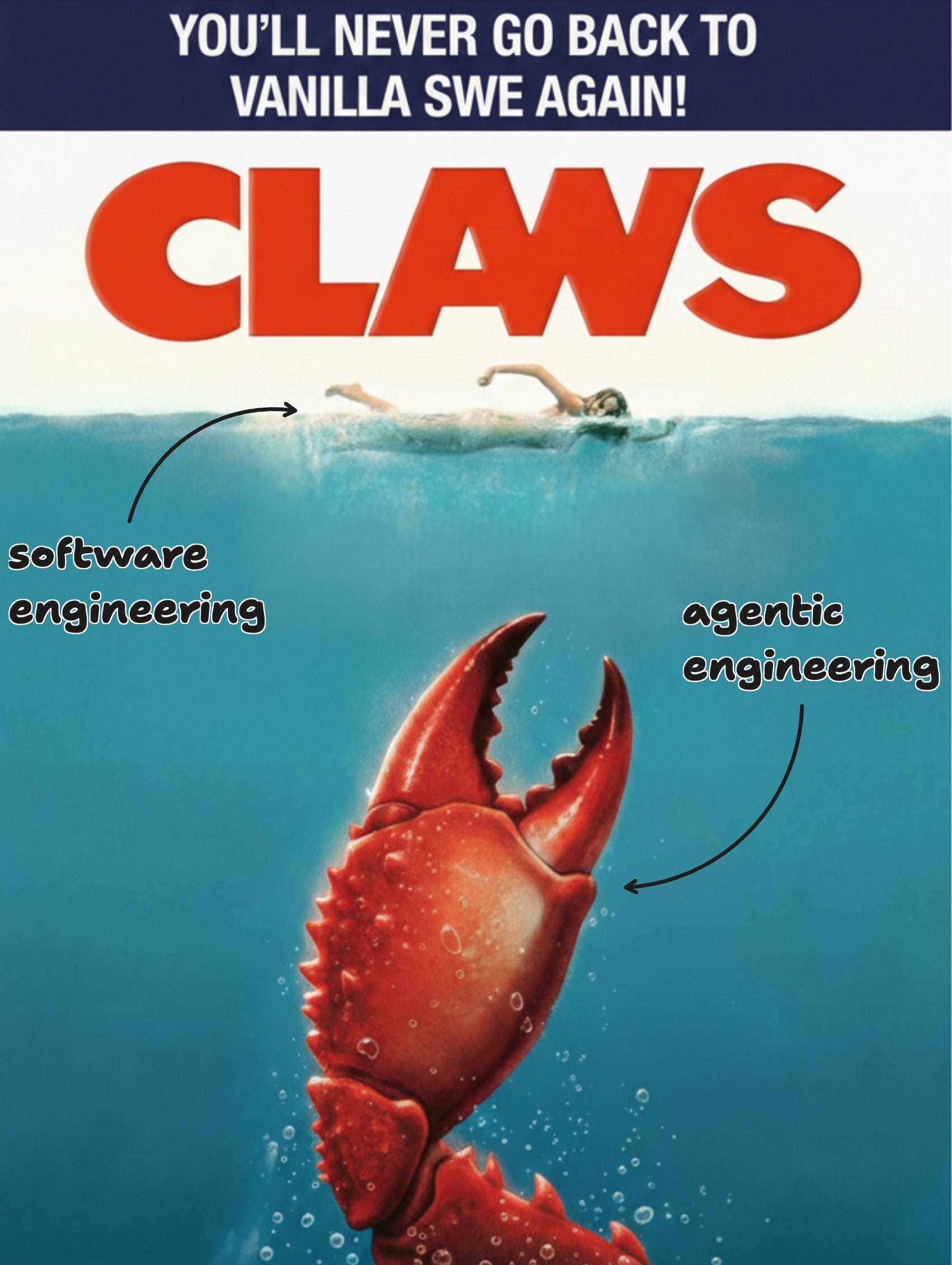
It’s a glimpse into a different way of building software.
2. A Preview of a New Builder Archetype
Clawdbot reveals a shift in who builds effectively in an AI-native world. It’s not necessarily the fastest coder, the one most fluent in a specific framework, or even the one with the most programming experience. Instead, it points to a new builder archetype shaping the transition to an agentic engineering landscape.
In this model:
Code is disposable. You are willing to delete large chunks and rewrite them if the iteration loop teaches you something new.
Feedback loops are sacred. The real work isn’t typing code, it’s designing tight cycles of thinking, execution, and verification, then letting agents run those loops relentlessly.
Product taste is the real moat. The hardest problem isn’t getting something to work; it’s making it feel “right” to the human on the other side.
Clawdbot uses AI, and that’s cool. But what sets it apart is how AI is used: not as a shortcut or for brainless prompting, but as a collaborator operating inside well-designed loops. That distinction quietly changes everything about how software will be built from here on out.
3. Where these ideas come from
The way Clawdbot was built makes more sense once you look at the creator. Peter Steinberger is not new to software or product thinking. He spent over a decade building PSPDFKit as a founder and CEO, staying close to the code and deeply involved in product decisions. After selling his stake and stepping away for a few years, he’s back and building again.
That background matters. His “vibe coding” sessions naturally look different from the efforts of most engineers. Listening to Peter discuss the project on TBPN and The Pragmatic Engineer, what stands out is his comfort level working with AI. There is no anxiety about being replaced and no hesitation to experiment with a beginner’s mindset, likely aided by his break from day-to-day engineering. This created space to treat agents as genuine collaborators.
Yes, Peter has advantages: experience, time, and the freedom to experiment. But those are only a small part of the story. The transferable part is how he uses that freedom. He stays intensely curious, plays with ideas instead of over-planning, and works hard to close feedback loops quickly.
In a fast-moving landscape, those traits matter more than ever. Agentic engineering may reward privilege to some extent, but it rewards care, curiosity, and repetition far more consistently.
4. Why coding is no longer the moat
For a long time, speed in software engineering meant one thing: how fast you could write correct code.
That made sense in a world where humans were the bottleneck. The faster you think & solve, the faster you ship. The better you knew a language or framework, the more leverage you had.
Raw execution speed is no longer scarce. You can spin up agents that generate implementations, refactors, and fixes faster than any single engineer ever could. In that world, writing code stops being the bottleneck. Deciding what to write, how to guide it, and importantly, when to throw it away becomes the real work.
This is where the idea that “code is disposable” starts to make sense.
Disposable does not mean careless. It means you are not emotionally attached to the first version. If an agent produces something that teaches you more about the problem than about the solution, you delete it and move on. The value is in what the loop revealed, not in preserving the output.
Speed now comes from something subtler. It comes from understanding how agents fail. From anticipating what context they will miss. From knowing when a prompt needs structure and when it needs freedom.
This is what people loosely describe as “getting the vibes.” But it is not intuition in the mystical sense. It is pattern recognition built through repetition. After enough loops of disposing code and writing prompts, you develop a feel for what an agent will misunderstand, what it will overfit to, and what it can safely be trusted with. And, through these iterations, you will get more context about the problem at hand. Gaining exposure from different angles through various responses helps you better approach a solution, disguised as a better prompt.
That is why coding, by itself, is no longer the moat and treating code as disposable is a practice of the hour.
5. Closing the loop is where engineering comes back
Closing the loop is about thinking about features in a way that makes them plannable, executable, and testable.
This is where the essence of engineering shows up.
When you work agentically, you are forced to think about a feature from multiple angles at once. What is the architecture? What is the approach? What constraints matter? How would this be tested? How would failure show up?
Peter mentioned that he now thinks about architecture and system design even more than before, despite agents doing most of the coding. That might sound counterintuitive, but it makes sense. When execution becomes cheap, judgment becomes visible.
Pair that kind of upfront thinking with fast feedback from agents, and something interesting happens. You immediately see the consequences of your architectural decisions. The loop from idea to implementation to validation closes quickly.
By moving through ideation, planning, execution, and testing in quick succession, you keep architectural judgment close to its outcomes. The process becomes verifiable, not just in code, but in thinking. You are exercising judgment continuously, not upfront and then again months later, as often happens in larger orgs and teams.
A useful mental model here is local CI. Just as continuous integration constantly verifies that changes do not break the system, well-designed agent loops continuously verify that progress is real. When something fails, the loop catches it early and course-corrects before it turns into wasted effort.
This is also why agentic engineering is the opposite of vibe coding. Vibe coding hopes the output is good. Closing the loop proves it.
Once those loops are in place, the leverage compounds. You are no longer supervising every line of code. You are designing systems where ideas reliably turn into working software.
6. What still matters: product taste
Once coding becomes cheap and loops become fast, the hardest part of building is yet to arrive.
The main difficulty is no longer getting something to work. It is making it feel right.
Peter was explicit about this. Even with agents doing much of the execution, the hardest problem remained figuring out how to make the product feel magical to the user.
This is where product taste becomes the real moat.
Taste is hard to define and even harder to automate. It lives in decisions that are difficult to test directly. It takes shape in the questions you ask about the product and the user. In what environment will the user interact with the product? How will the interaction take place? And what will bring delight to the user?
Agents can help you explore options. They can prototype variations and surface trade-offs quickly. But they cannot decide what feels right. That judgment still comes from a human who cares deeply about the experience on the other side.
This is also why Clawdbot resonated the way it did. Its popularity was driven more by product taste and freedom than by raw capability.
That combination matters more than ever. Code can be rewritten. Loops can be tightened. Infrastructure can be copied. Taste compounds quietly over time.
What I’m taking away
Clawdbot’s success isn’t just a glimpse into personal assistants. It is a preview of a new builder archetype.
Someone who treats code as disposable, loops as sacred, and product taste as the real moat.
That framing has helped me make sense of the current AI engineering landscape.
In experimentation. In judgment. In feedback. In care.
What I’m focusing on next:
Designing tighter loops between planning, execution, and verification..
Building intuition by experimenting relentlessly with new models.
Caring more about the end-user experience than the implementation..
If there’s one reassuring takeaway in all of this, it’s that this landscape does not reward hype or shortcuts for long. It rewards curiosity, repetition, and people who care enough to keep refining their taste through building real stuff.
That’s a version of engineering I’m excited to grow into.
Inspired by Peter Steinberger’s appearances on The Pragmatic Engineer podcast and TBPN.
Thanks, this clarifys a lot. Can you elaborate on the agent workflow?